Wiki Applications and The Long Tail
2011-06-04 - 05:38:19 by PeterThoeny in Social Business

What is TWiki?

A leading open source enterprise wiki and web application platform used by 50,000 small businesses, many Fortune 500 companies, and millions of people.
 Learn more.
Learn more.
 ? From Wikipedia: "The Long Tail refers to the statistical property that a larger share of population rests within the tail of a probability distribution than observed under a 'normal' or Gaussian distribution. The Long Tail was popularized by Chris Anderson in an October 2004 Wired magazine article, in which he mentioned Amazon.com and Netflix as examples of businesses applying this strategy."
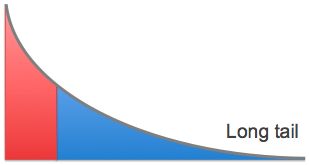 and other companies started to focus on low priced high volume deals. That is, the sales action shifts to the long tail (the right side of the graph.)
You might be wondering, what the long tail have to do with wikis? Structured Wikis are in the long tail of implementing business processes. But how?
Large scale business processes are typically implemented by the IT department, for example to comply with the Sarbanes-Oxley Act, to deploy a CRM application, a traditional CMS, or the like. Those systems have a long procurement and development cycle, e.g. they are on the left side of the graph. On tho other side, teams follow formal and informal workflows to accomplish tasks. This is often a paper-based process, such as rolling out laptops to employees, maintaining a status board of a call-center, or signing-off software to be compliant with export regulations. The IT department typically has not enough bandwidth to implement lightweight applications to automate those processes.
A wiki lends itself to support evolving processes. First by enabling employees to document processes in the free-form wiki way, with linked pages that are maintained collaboratively. Secondly, by creating structured wiki application with forms, queries and reports that automate those processes. Those applications are typically done in iterations - in bazaar-style. In The Cathedral and the Bazaar, Eric S. Raymond compared two different styles in software development, the "cathedral" model of most of the commercial world, versus the "bazaar" model of the free software world. A similar shift happens now when collaborating in a wiki and when implementing business processes. One could say, wikis take care of business processes with an open source approach.
An interesting question is: Who is implementing the applications that support the business processes? A CMS for example is deployed in cathedral-style: User requirements are collected by analysts, the system is designed and implemented by programmers, then deployed to the user base. The design is done with a focus on security, and more often than not, this ends up with a solution that is not so much customer focused.
When users are enabled to implement and deploy wiki applications in bazaar-style, they are their own customers. Because of that, and because of the iterative approach, they get a very customer focused solution. We see a paradigm shift from programmers creating applications to content contributors with moderate skill sets building applications. A similar shift happened when spreadsheet programs have been introduced to the mainstream. Spreadsheet calculations were once the realm of Wall Street, with highly specialized software and people. After the introduction of VisiCalc, people without programming background were enabled to create spreadsheet programs that solved complex and very specific problems.
"Content contributors with moderate skill sets building applications" is actually a bit exaggerated. It assumes that structured wikis are as easy to program as spreadsheets. TWiki already has all the Lego blocks, but more work needs to be done on the usability side. For now, it is often the wiki champions who create the wiki applications, and who coach other users in creating them.
and other companies started to focus on low priced high volume deals. That is, the sales action shifts to the long tail (the right side of the graph.)
You might be wondering, what the long tail have to do with wikis? Structured Wikis are in the long tail of implementing business processes. But how?
Large scale business processes are typically implemented by the IT department, for example to comply with the Sarbanes-Oxley Act, to deploy a CRM application, a traditional CMS, or the like. Those systems have a long procurement and development cycle, e.g. they are on the left side of the graph. On tho other side, teams follow formal and informal workflows to accomplish tasks. This is often a paper-based process, such as rolling out laptops to employees, maintaining a status board of a call-center, or signing-off software to be compliant with export regulations. The IT department typically has not enough bandwidth to implement lightweight applications to automate those processes.
A wiki lends itself to support evolving processes. First by enabling employees to document processes in the free-form wiki way, with linked pages that are maintained collaboratively. Secondly, by creating structured wiki application with forms, queries and reports that automate those processes. Those applications are typically done in iterations - in bazaar-style. In The Cathedral and the Bazaar, Eric S. Raymond compared two different styles in software development, the "cathedral" model of most of the commercial world, versus the "bazaar" model of the free software world. A similar shift happens now when collaborating in a wiki and when implementing business processes. One could say, wikis take care of business processes with an open source approach.
An interesting question is: Who is implementing the applications that support the business processes? A CMS for example is deployed in cathedral-style: User requirements are collected by analysts, the system is designed and implemented by programmers, then deployed to the user base. The design is done with a focus on security, and more often than not, this ends up with a solution that is not so much customer focused.
When users are enabled to implement and deploy wiki applications in bazaar-style, they are their own customers. Because of that, and because of the iterative approach, they get a very customer focused solution. We see a paradigm shift from programmers creating applications to content contributors with moderate skill sets building applications. A similar shift happened when spreadsheet programs have been introduced to the mainstream. Spreadsheet calculations were once the realm of Wall Street, with highly specialized software and people. After the introduction of VisiCalc, people without programming background were enabled to create spreadsheet programs that solved complex and very specific problems.
"Content contributors with moderate skill sets building applications" is actually a bit exaggerated. It assumes that structured wikis are as easy to program as spreadsheets. TWiki already has all the Lego blocks, but more work needs to be done on the usability side. For now, it is often the wiki champions who create the wiki applications, and who coach other users in creating them.

- http://twiki.org/cgi-bin/view/Codev/StructuredWiki - Structured Wikis
- http://en.wikipedia.org/wiki/Long_Tail - The Long Tail
- http://en.wikipedia.org/wiki/Sarbanes-Oxley_Act - Sarbanes-Oxley Act
- http://en.wikipedia.org/wiki/Customer_relationship_management - Customer relationship management (CRM)
- http://en.wikipedia.org/wiki/Content_management_system - Content management system (CMS)
- http://www.catb.org/~esr/writings/cathedral-bazaar/cathedral-bazaar/index.html - The Cathedral and the Bazaar, Eric S. Raymond
- http://twiki.org/cgi-bin/view/Codev/TWikiConsultants - TWiki Consultants
- http://twiki.org/cgi-bin/view/Blog/BlogEntry201009x1 - How to Create a TWiki Application
Comments
Excellent blog Peter. My bet is that wiki applications will be main stream sooner than later and the long tail will be amazingly big. -- Victor Heredia via Facebook - 2011-06-04
Thanks Victor! Yes, it feels like a quiet revolution.
--
Victor Heredia via Facebook - 2011-06-04
Thanks Victor! Yes, it feels like a quiet revolution.
--  Peter Thoeny - 2011-06-04
 Edit | Attach |
 Topic revision: r2 - 2011-06-04 - PeterThoeny


 Site map
 Blog web

 Write New Post
 Blog Feed (ATOM)
 Changes
 Search
 Notifications
 Index
Index Statistics
 Preferences


 Account

 |
 |
|
|
|


 Ideas, requests, problems regarding TWiki? Send feedback. Ask community in the support forum.
Copyright © 1999-2026 by the contributing authors. All material on this collaboration platform is the property of the contributing authors.