Addressing Customer Value Using Structured Wikis - Personas and Kanban Approach,
Presentation for Siemens, Munich, Germany
This is the presentation material for the 80 minute talk on "Addressing Customer Value Using Structured Wikis - Personas and Kanban Approach" at Siemens, 2013-01-17.
Abstract: A wiki enables teams to organize and share content and knowledge in an organic and free manner, and to schedule, manage and document their daily activities. TWiki is a leading open source enterprise wiki deployed in 50K organizations and used by millions of people. Learn from the founder of TWiki and co-author of the Wikis for Dummies book how to best deploy a wiki at the workplace to enhance the communications within and between organizations. Learn also how a structured wiki can automate your workflows and how it helps transform your organization into a lean and agile enterprise. Case studies of Morgan Stanley, Wave Systems and other organizations are covered to show large scale deployments and various development methodologies using kanban, viewpoints, personas, user stories and more.
See also: What is TWiki, Public TWiki Sites, TWiki Screenshots, TWiki.org Blog

 | Copyright © 2013 by TWiki.org. This presentation may be reproduced as long as the copyright notice is retained and a link is provided back to http://twiki.org . . |  |

Slide 1: Addressing Customer Value Using Structured Wikis
Personas, User Stories & Kanban Approach
- Wiki, a writable web: Communities can share content and organize it in a way most meaningful and useful to them
- A structured wiki combines the benefits of a wiki and a database application
- Learn how a structured wiki can address customer value by automating your workflows
- Case studies of Morgan Stanley, Wave Systems and aseaco show large scale deployments and various development methodologies using kanban, viewpoints, personas, user stories and more.
Slide 2: About Peter
- Peter Thoeny
- CTO and Founder of TWiki.org, an Enterprise Collaboration Platform provider
-
 Founder of TWiki, the open source wiki for the enterprise, managing the project for 10+ years
- Invented the concept of structured wikis - where free form wiki content can be structured with tailored wiki applications
- Thought-leader in wikis and social software, featured in numerous articles and technology conferences including LinuxWorld, Business Week, Wall Street Journal and more
- Graduate of the Swiss Federal Institute of Technology in Zurich
- Lived in Japan for 8 years, developing CASE tools
- Now in the Silicon Valley for 10+ years
- Co-author of Wikis for Dummies book
Slide 3: Agenda
- Enterprise Collaboration Space
- What is a Structured Wiki?
- Case Study: Wave Systems
- Case Study: Morgan Stanley
- Case Study: Aseaco
- Initial deployment of a structured wiki
Slide 4: Enterprise Collaboration Landscape Today - Enterprise 2.0

Slide 5: Trend "Enterprise Wiki" & "Social Business"

Slide 6: SharePoint: The Standard -- But High TCO

- SharePoint: High TCO mainly due to licensing, staffing, consulting
- Structured Wiki: Morgan Stanley deploys TWiki for 30K employees with zero licensing cost & staff of three administrators/programmers
Slide 7: Competitive Landscape of Wikis & Enterprise 2.0

Slide 8: Structured Wiki = Enterprise Wiki & Wiki Application Platform

Slide 9: What is a Structured Wiki?
- Goal of a structured wiki:
- Combine the benefits of a wiki and a database application
- Wiki:
- Organic & never complete: Content & structure is open to editing and evolution
- Open: Readers can refactor incomplete or poorly organized content at any time
- Hyper-linked: Many links to related content due to WikiWord nature
- Trust: Open for anyone to edit, "soft security" with audit trail
- Database application:
- Highly structured data
- Easy reporting
- Workflow (e.g. purchase requisition)
- Access control
Slide 10: Usage Pattern in a Structured Wiki
- Users typically start with unstructured wiki content
- Example: Call-center status board
- User discovers patterns in content
- Example: Call-center status board has fixed list of users and fixed list of time slots
- User or administrator builds an application, typically in iterations
- Goal: Automate tasks based on discovered patterns
- In other words: A structured wiki enables users to build lightweight applications
Slide 11: Example: Call-Center Status Board, v1
- Requirement for status board:
- Easily see who is on call at what time
- Easily change the status board
- Start with a simple bullet list for status board v1:
- 07:00am - 11:00am: Richard
- 11:00am - 03:00pm: Peter
- 03:00pm - 07:00pm: Sam
- See CallCenterStatusBoard example
Slide 12: Example: Call-Center Status Board, v2
- Status board v1 does the job, but lets make it more presentable and useful:
- Convert the bullets into a table
- Use WikiWord links to team member's home pages for easy reference
- Add Backup person
- Improved status board v2:
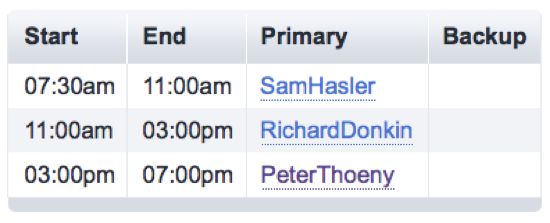
- See CallCenterStatusBoardV2 example
Slide 13: Example: Call-Center Status Board, v3
- Status board v2 is presentable, now lets make it more user friendly:
- Use the TWiki:Plugins.EditTablePlugin to select the times and names from a list
- Use the TWiki:Plugins.EditTablePlugin
- Improved status board v3, view and edit:
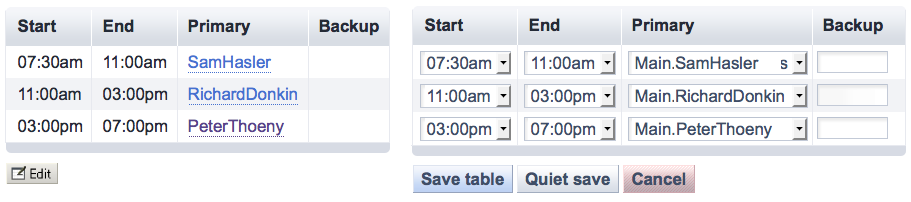
- See CallCenterStatusBoardV3 example
Slide 14: What is TWiki?
-
 TWiki is a wiki engine and wiki application platform, established in 1998
- TWiki is specifically built for the workplace
- Large number of TWiki Extensions: 200+ actively maintained extensions
- Open Source software (GPL) with active community, hosted at http://TWiki.org/
- 4,000+ downloads per month, 600,000 total downloads, estimate 50,000+ installations, 130+ countries
- Est. $27M of human capital invested (ref. Ohloh)
- Source Forge 2009 "Best Enterprise Project" Finalist (among 230,000 open source projects)
Slide 15: TWiki Open Source Community
-
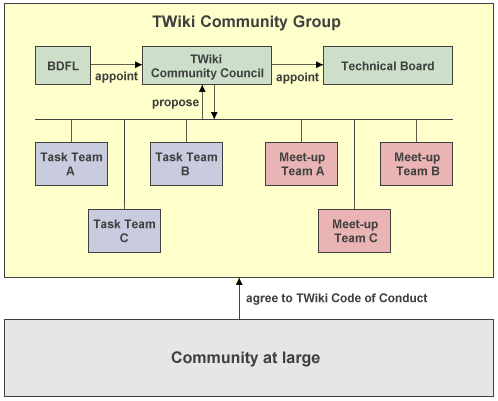 Clear mission, charter, roadmap and release focus
- 10+ years - several iterations on governance
- Ubuntu style community governance and code of conduct since Oct 2008
- Small but helpful & inviting community
- Call to action: Get involved!
Slide 16: Under the Hood: TWiki I/O Architecture

Slide 17: Personas for TWiki Development

- The Inmates Are Running the Asylum: Why High Tech Products Drive Us Crazy and How to Restore the Sanity, ISBN:978-0672326141
- By Alan Cooper (inventor of Visual Basic)
- Simple interface-design philosophy:
- Define the personas
- Define their goals
- Work to meet those goals
Slide 18: Personas for TWiki Development - Example

Slide 19: Guiding Lean Principles at Siemens

Slide 20: Case Study: Wave Systems -- "Helping Redefine Cyber Security"

- Established: 1988
- Employees: 1000+
- HQ: Lee, MA, USA
- Offices: Cupertino CA, Princeton NJ, Frankfurt, London, Paris, Tel Aviv, The Hague, Zurich
- Disclaimer: Presenter provides consulting services to Wave Systems
Slide 21: Wave Systems: Products
| Core Capabilities | Cyberspace Solutions | |||
 Hardware Roots of Trust (as Leaders of Trusted Computing Group Standards)  Trusted Drive Management (Self Encrypting Drives, Bitlocker)  Public Key Infrastructure Management (Wave Service Key Sets) |
 Safend Content Privacy  Encryption |
 Social Media and File Sharing Privacy  Wave Epistery - the Known Endpoint Solution for Identity and Trusted Transactions  Endpoint Management for Enterprises and People (Wave Cloud) | ||
Slide 22: Wave Systems: Questions
- How can we bring distributed teams together most effectively?
- How can we be more agile and refocus our products based on new market needs?
- How can (re-)structure the company and culture to best add value to customers?
- How can we accelerate R&D and reduce the time to market? (Accelerating pace of innovation)
Slide 23: Wave Systems: WCKE with Kanban, Personas & User Stories

- Solution: WCKE - Wave Collaboration and Knowledge Engineering system
- Suite of TWiki-based applications to support the workflow of employees
- Personalized dashboard
- Two views into content:
- Viewpoints
- Work Centers
- Viewpoint: Viewpoint Users (personas), User Stories, Structured Views
- Dashboards for Work Centers: Business Units, Programs, Projects
- Kanban board in Work Center dashboards: Input queue (to do), in-progress queue, output queue (done)
- Distinct work items & try to minimize in-progress queue
- Supporting tracker apps: Action Items, Artifacts, Deliverables, Meetings, ...
Slide 24: Wave Systems: Personalized Dashboard

Slide 25: Wave Systems: My Network

- William Frank, Chief Architect at Wave Systems is the key architect of the WCKE system
Slide 26: Wave Systems: Viewpoint

Slide 27: Wave Systems: Viewpoint Users

Slide 28: Wave Systems: User Stories

Slide 29: Wave Systems: Structured Views

Slide 30: Wave Systems: Project Dashboard

- Kanban board in Work Center dashboards: Input queue, in-progress queue, output queue
- Distinct work items & try to minimize in-progress queue
Slide 31: Wave Systems: Action Item List

Slide 32: Wave Systems: Action Item

Slide 33: Wave Systems: Artifact

Slide 34: Case Study: Morgan Stanley

Slide 35: Morgan Stanley: Scale of Structured Wiki Deployment

- The sheer scale of the deployment at Morgan Stanley is staggering in enterprise scale terms:
- 30,000 employees use the platform
- 4+ Million page views per month (does not include crawlers)
- 300,000 updates/month
- 500,000 web pages managed in the system
- Managed across 3 Data Centers with HA (high availability)
Slide 36: Morgan Stanley: Use Cases - "Mission Critical"
- Primary use:
- Technical Operations Manuals - Document storage for the IT teams to manage day to day operations of their software assets
- Software Product Documents - A place for their internal teams to store documents during the development of their internal software
- Team Workspaces - Webs for their teams to share/collaborate project content such as project status, meeting minutes, and progress reports
- Data aggregation - 5000+ TWiki topics retrieving data from other systems such as RSS feeds, Jira, trouble ticket system, change management system, RDBMS, SharePoint, etc.
- Source & detail: http://twiki.org/cgi-bin/view/Blog/BlogEntry201110x1
Slide 37: Case Study: Aseaco

Slide 38: Aseaco: Introduction
- Aseaco is a consulting company based in Groß-Gerau, Germany
- Aseaco integrates TWiki with several legacy systems - especially SAP
- Structures of these systems are used to generate the TWiki Topic structure to offer content and TWiki application.
- Defined UIF (Ubiquitous Information Framework) for integration purposes.
- Ability to exchange information between systems like SAP and TWiki bidirectionally.
- Solutions to support the product life cycle management and product data management.
- NOTE: Aseaco is part of a large international Siemens project. A aseaco consultant is responsible for the integration of Team Center and SAP.
Slide 39: Aseaco: Example: Automotive Industry
- Support of the stage-gate approach of a automotive company.
- The stage-gate approach is described with a special UIF-Language - Business Collaboration Execution Language (BCEL®)
- UIF generates wiki content and functions at the right time with the correct authorization settings.
- BCEL® controls the process by rule configuration.
Slide 40: Aseaco: Project Summary
- Wiki page with different functions.
- Overview of all gates, financial status and project schedule.

Slide 41: Aseaco: Timeline Visualization
- UIF generates the timeline by using easy timeline plugin

Slide 42: Aseaco: Overview of a Project Phase
- The user is able to navigate to collaboration rooms for project activities
- Status visualization by using gauge plugin

Slide 43: Aseaco: Ticket System for Serial Production
- When serial production starts - the wiki system offers ticket applications for handling production issues.

Slide 44: Initial Deployment of a Structured Wiki
- Plan content and rollout
- Pain killer vs. vitamin
- Build initial structure & wiki apps
- Populate initial content with help from early adopters
- Initial rollout with smaller group
- Train and coach users
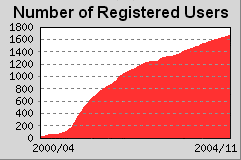
- Do not underestimate inertia and time
- Expect quick growth after slow start
- Example: Wind River's wiki has now 120K pages and 20K page changes / month
- Example: Wind River's wiki
Slide 45: Role of Wiki Champion
- A wiki champion is a person who:
- understands the process of the work for a given project or business (the domain), and
- knows how to use a wiki (best practices in collaboration)
- The wiki champion is coaching the employees
- Advocate, important role especially in the initial phase of a wiki
- Typically a part time role
- As the wikis gets larger and grows laterally, new wiki champions emerge
Slide 46: Be Aware of Mental Barriers

- Wikis can be intimidating; the wiki pages appear "official" and corporate
- Overcome your own internal resistance to edit existing content
- Paradigm shift: Content is owned by team, not individual
- I want my contributions to be near "perfect"
- It is more effective to post content early and let the team provide feedback and revise it iteratively
Slide 47: Social Media at Work: Viral Shift towards Information Age

- Details: TWiki.org blog Social Media at Work: Viral Shift towards Information Age
Slide 48: Summary
- A structured wiki is a powerful platform for web collaboration
- Collaborate in free form; add structure as needed
- Use it as a platform to create lightweight applications
- Automate your workflow
- Structured wikis help transform your organization into a lean and agile enterprise
- Easy to share knowledge
- Corporate brain gives a competitive advantage
- Careful coaching is needed
- Offer user training and wiki champion training
- Viral growth after people "get it"
Slide 49: How Can a Structured Wiki Help Your Organization?

This presentation: http://bit.ly/twPres13
(http://twiki.org/cgi-bin/view/Codev/TWikiPresentation2013x01x17) -- Peter Thoeny - peter09@thoeny.org - TWiki.org
(http://twiki.org/cgi-bin/view/Codev/TWikiPresentation2013x01x17) -- Peter Thoeny - peter09@thoeny.org - TWiki.org
Slide 50: BACKUP SLIDES
BACKUP SLIDES
Slide 51: Wikipedia - The 800 Pound Gorilla
- Wikipedia: Wiki + Encyclopedia

- A free encyclopedia written collaboratively by you
- Project started in January 2001
- The most active public wiki: 4,000,000 articles and 18,000,000 registered users in the English language Wikipedia alone (ref. Wikipedia statistics)
- Anyone in the world can edit any page.
- Doesn't that lead to chaos?
- Content can be freely distributed and reproduced under the terms of the GNU Free Documentation License (GFDL)
 BUT: Reality of edit wars, and larger interest groups overpowering smaller groups
Slide 52: IBM Research: history flow of Islam article on Wikipedia

Slide 53: Enterprise Collaboration Landscape Today - Web 2.0

Slide 54: Structured Wiki Applications - Whet Your Appetite

- Event tracker of Peninsula Swiss Club
- Outage tracker of an IT organization
- Sales Pipeline Tracker of Twiki, Inc.
Slide 55: Demo: Event Tracker

Slide 56: Demo: Outage Tracker

Slide 57: Demo: Sales Pipeline Tracker

Slide 58: TWiki in Action

Slide 59: What is TWiki used for?
- Shared notebook for teams: Projects, repository, scheduling, meetings
- Departmental collaboration tool: Processes, project reviews, QA tracking
- Intranet publishing tool: IT, HR, ISO standards
- CMS with focus on free-form collaboration: Requirements capture
- Knowledge base: Problem/solution pairs with attached patches
- TWiki started its life as a KB for support
- TWiki started its life as a KB for support
- Platform to create wiki applications, such as news portals, inventory systems, issues tracking systems
Slide 60: Who is using TWiki?
- Many corporations, such as 3Com, AMD, Alcatel, AT&T, Boeing, ... Xerox
- BT, Disney Corp, Motorola, SAP, TI, Wind River and others have submitted success stories
- Major TWiki deployments: Google, Motorola, Nokia, Oracle, Wind River
- BT, Disney Corp, Motorola, SAP, TI, Wind River and others have submitted success stories
- Academia, such as Biowiki of UC Berkeley
- Government, such as NIST Cloud Computing Collaboration Site
- Also Internet communities, such as XP Days Germany
- Browse public TWiki sites to see how is using TWiki in various ways
Slide 61: Challenges of Static Intranets
-
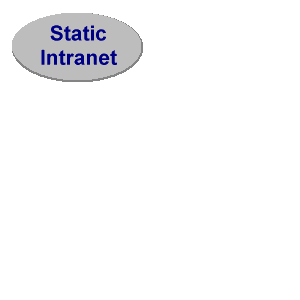 Some content is outdated
- Incomplete content
- When was the page last updated?
- Difficult to find content
- Inconsistency across departments
- Special tools, knowledge and permission required to maintain
- Content is static, it has a "webmaster syndrome":
If an employee discovers a page with incorrect or insufficient information, the employee will often ignore it because it takes too much time to find out who the webmaster is and to write an e-mail requesting an update
Slide 62: Wikis and Static Intranets
-
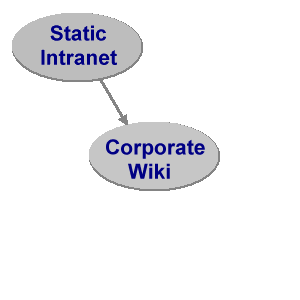 Move some/all Intranet content into a wiki
 - No difference for readers to browse and search content
- Employees are empowered to fix content on the spot
- Ease of maintenance
- No need to install client side software
- Consistent look & feel
- Paradigm shift
- from: webmasters maintain content
- to: domain experts and casual users maintain content
Slide 63: Challenges of E-mail
-
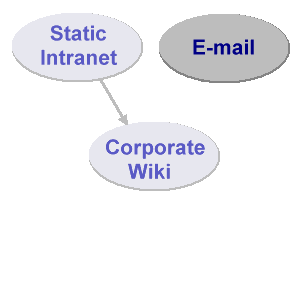 E-mail and mailing lists are great, but:
 - Post and reply vs. post and refine/refactor
- Great for discussion, but ... hard to find "final consensus" on a thread
- E-mail is not hyper-linked and is not structured, content can't be grouped easily into related topics
- E-mail and attachments are not version controlled and it is difficult to determine the history of a document
- Not all interested people / too many people in the loop
Slide 64: Wikis and E-mail
-
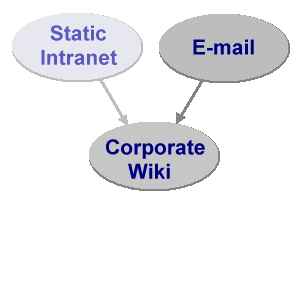 Move some e-mail traffic into a wiki
 - Ease of reference (cross-linking)
- Flexible notification (favorites only, daily digest, RSS/ATOM feed)
- Pockets of knowledge made available to interested parties
- Audit trail / domain experts
- Paradigm shift
- from: post & reply
- to: post & refine & cross-link
- Send e-mail with link to content instead of content itself
Slide 65: Challenges of Business Processes
-
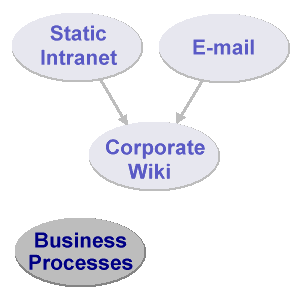 Business processes are implemented in large scale by IT department (Sarbanes-Oxley compliance etc.)
- Teams follow formal/informal workflow to accomplish tasks, which is often a paper-based process (rolling out laptops to employees etc.)
- No resources allocated to implement applications to automate these processes; IT department has no bandwidth to implement lightweight applications for a variety of teams
Slide 66: Wikis and Business Processes
-
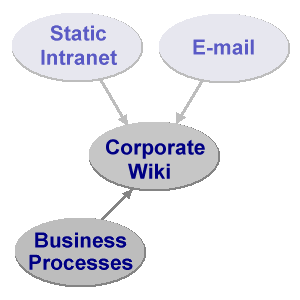 A structured wiki is a flexible tool to support evolving processes
 - in the free-form wiki way -- linked pages, collaboratively maintained
- and with a structured wiki application -- forms, queries, reports
- Content contributors with moderate skill sets can build web applications
- Paradigm shift
- from: programmers create applications
- to: all of us can build applications
Slide 67: Requirements for a Wiki at the Workplace
- Version control -- audit trail
- Access control -- security
- File attachments -- document management
- Ease of use -- productivity
- Ease of administration -- productivity
- Feature set -- create web applications
- API -- integration with existing enterprise applications
- Scalability -- room to grow
- Support -- get help when needed
Notes
- This presentation is available at http://twiki.org/cgi-bin/view/Codev/TWikiPresentation2013x01x17
-
 Download PDF version of this presentation
- Please provide feedback at TWiki:Codev/TWikiPresentation2013x01x17Feedback
- Only TWikiAdminGroup can change this topic; view topic in raw format
- Set ALLOWTOPICCHANGE = TWikiAdminGroup
- This presentation is based on the SlideShowPlugin and uses the TWiki:Main/PeterThoenySlideShowTemplate
| | Copyright © 2013 by TWiki.org. This presentation may be reproduced as long as the copyright notice is retained and a link is provided back to http://twiki.org. | |
 Peter Thoeny - 2013-01-17
Topic revision: r16 - 2014-05-30 - PeterThoeny


 Site map
 Blog web

 Create New Topic
 Index
Index Search
 Advanced search
 My topics of interest
 Changes
 Major changes only
 All tags
 Notifications
 RSS Feed
 Statistics
 Preferences
 Community
  Readme first
 Developers News
 How you can help
 Community roles
 #twiki IRC
 Lima Release
 Feature Proposals
 Bugs Changes
 Categories


 Account





 Ideas, requests, problems regarding TWiki? Send feedback. Ask community in the support forum.
Copyright © 1999-2026 by the contributing authors. All material on this collaboration platform is the property of the contributing authors.