Question
Advise on how to Protect Text From Interpretation Consider the following form-based query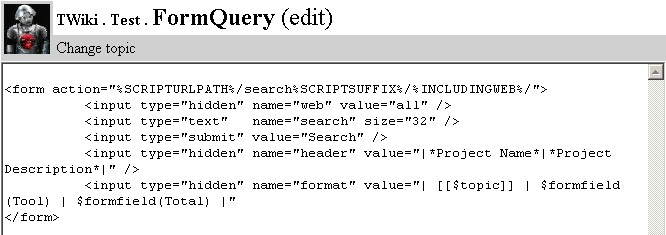 Unfortunately, this query results in the following form:
I tried various ways of escaping the interpretation of the square brackets that apparently break the parsing of the whole line containing them. Any guidance would be greatly appreciated.
Unfortunately, this query results in the following form:
I tried various ways of escaping the interpretation of the square brackets that apparently break the parsing of the whole line containing them. Any guidance would be greatly appreciated.
Environment
| TWiki version: | TWikiRelease01Feb2003 |
| TWiki plugins: | DefaultPlugin, EmptyPlugin, InterwikiPlugin |
| Server OS: | N/A |
| Web server: | N/A |
| Perl version: | N/A |
| Client OS: | Win2k |
| Web Browser: | IE 6 |
Answer
This should work: Escape the link to show the value of"| [<nop>[$topic]] | $formfield(Tool) | $formfield(Total) |", e.g.:
-- PeterThoeny - 02 Jan 2004
I changed the query above to "| [<nop>[$topic]] | $formfield(TopicClassification) | $formfield(OperatingSystem) |"
It turns out that one also has to escape the wiki words in the format. However, the wiki words in the header parameter do not need to be escaped:
Could you please explain the difference in how these are handled?
-- ThomasWeigert - 02 Jan 2004
This is because OperatingSystem in the header is bolded. The autolinking is only done for WikiWords preceeded by white space or opening parenthesis.
In the form you need to <nop>EscapeWikiWords one by one, or enclose the whole form in <noautolink> ... </noautolink> tags.
-- PeterThoeny - 02 Jan 2004
Thanks. However, the <noautolink> ... </noautolink> trick does not seem to work for me:
-- ThomasWeigert - 02 Jan 2004
<noautolink> only escapes WikiWord links as documented; the [[...][...]] links need to be escaped separately (as well as other TWiki rendering like bold etc)
-- PeterThoeny - 02 Jan 2004
I found another way to create a problem, as can be seen by the query below. As you can see, the insertion of HTML image reference messes up the rendering again:
-- ThomasWeigert - 31 Jan 2005
Do this: - Use
noautolinktags to prevent WikiWord linking - Entity encode special chars for use in input value parameter, such as
%ENCODE{ "text to encode" type="entity" }% - No need to use
noptags - Double quotes need to be escaped with
\"
value="%URLPARAM{ "foo" encode="entity" }%"
-- PeterThoeny - 06 Feb 2005
Note that when using %ENCODE% one cannot apply <nop> to protect linking (see the incorrect result):
However, <noautolink> can be applied at any level, and need not be around the whole form (in case linking within the form is desired, as in WebSearch):

Topic revision: r10 - 2005-02-07 - ThomasWeigert


 Site map
 Blog web

 Search
 Changes
 RSS Feed
 Notifications
 Statistics
 Preferences
 Register new user
 Support Forum
  Ask a question
 Open questions
  My recent questions
 Get quick help in #twiki IRC channel


 Ideas, requests, problems regarding TWiki? Send feedback. Ask community in the support forum.
Copyright © 1999-2026 by the contributing authors. All material on this collaboration platform is the property of the contributing authors.